
Marine Instruments, Satlink and Zunibal sign landmark joint declaration for sustainable echosounder buoy stewardship
- For the first time, the three principal global manufacturers of satellite buoys have signed a joint agreement to coordinate action on dFAD recovery, traceability and data-based fisheries management.
- The declaration establishes three shared action areas, prevention, recovery and circularity, and data sharing, aligning the companies’ existing programmes under a common stewardship framework.
- Alongside the declaration, the three companies have co-authored Smart Buoys and Sustainable Tuna Fisheries, a joint technical publication for fishing companies, scientists and fisheries management bodies.
June 3, 2026, Derio (Bizkaia) – Marine Instruments, Satlink and Zunibal, the three leading global manufacturers of satellite buoys, have signed a Joint Declaration of Intent for Sustainable Echosounder Buoy Stewardship, marking an unprecedented agreement in the sector and a major step towards more responsible and collaborative dFAD management in tropical tuna fisheries.
Echosounder buoys are satellite-connected devices attached to drifting Fish Aggregating Devices (dFADs) used in tropical tuna fisheries to monitor their location and movement. These smart buoys also provide real-time information on the presence of tuna beneath them, enabling more efficient, selective and sustainable fishing operations. However, dFADs can potentially drift outside fishing areas and become difficult to recover, raising the need for more coordinated management approaches across the supply chain.
The declaration was formally signed on 18 March 2026, following its introduction at the Pacific Community (SPC) Drifting Fish Aggregating Device Workshop in Papeete, (French Polynesia) a forum bringing together governments, scientific institutions and fishing industry representatives to shape the future of responsible dFAD management. The three companies presented the joint approach during the session “Technology Providers’ Contribution to Responsible Buoy Use and Management”. It establishes a shared framework to strengthen cooperation, enhance accountability and traceability, reduce environmental impact, and support more data-based dFAD management.
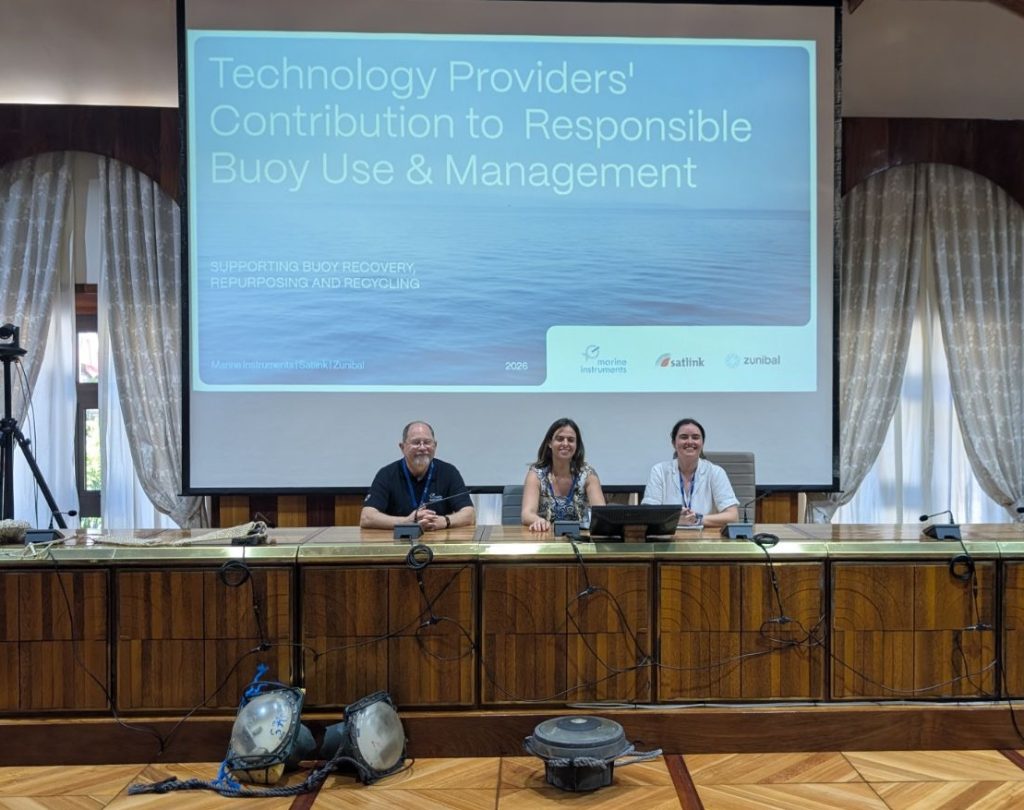
Patricia Ordóñez, Director of Science and Sustainability at Zunibal described the declaration as a shift towards closer coordination among providers around shared stewardship priorities. “Innovation drives our competition, but sustainability demands our unity,” she said. “We are proving that market leadership implies a shared responsibility. This declaration aligns our efforts to help ensure that the technology driving today’s catch also helps safeguard tomorrow’s fishery.”
Jorge Pérez-Bouzada, Sustainable Fishing Director at Marine Instruments, highlighted: “Responsible fisheries require innovation, collaboration and long-term commitment. This declaration shows that the leading buoy manufacturers can work together on key challenges such as traceability, recovery and circularity, contributing to responsible dFAD management and the long-term sustainability of tuna fisheries.”
Kathryn Gavira O’Neill, Head of Science & Sustainability Department at Satlink, emphasized: “This agreement is unique in our industry. For the first time, the three leading manufacturers of echosounder buoys have come together to take dFAD management a step further. Beyond providing technologies that enable more efficient and sustainable fishing operations, we are joining efforts to support the long-term future of the tuna industry.”
The collaboration establishes a shared framework built around three action areas:
- Prevention (supporting recovery initiatives): aligning systems to strengthen industry-led initiatives like FAD Watch, facilitating the early detection and prevention of stranding events.
- Recovery & Circularity: harmonising best practices from existing projects Blue Recovery (Marine Instruments), ReCon (Satlink), and SEARCLE (Zunibal) to improve buoy end-of-life management and explore shared collection hubs in strategic ports.
- Data as operational support: exploring mechanisms to responsibly share non-sensitive information, enhancing the understanding of dFAD behavior and supporting science-driven management by relevant institutions.
Alongside the declaration, Marine Instruments, Satlink, and Zunibal have co-authored the technical publication “Smart Buoys and Sustainable Tuna Fisheries“. This document serves as a resource to highlight how satellite buoys act as essential tools in support of the fishing industry’s objectives. It emphasizes how technological innovation provides the fleet with enhanced data to further improve operational efficiency and reinforces the sector’s ongoing commitment to food security and the responsible management of marine resources.
Together, the declaration and the technical publication reflect a shared commitment to move from isolated initiatives towards more coordinated action. By aligning practices around accountability, traceability, recovery, circularity and continuous improvement, Marine Instruments, Satlink and Zunibal aim to support more effective dFAD management, contribute to a more responsible blue economy, and help safeguard the long-term health of the marine ecosystem.